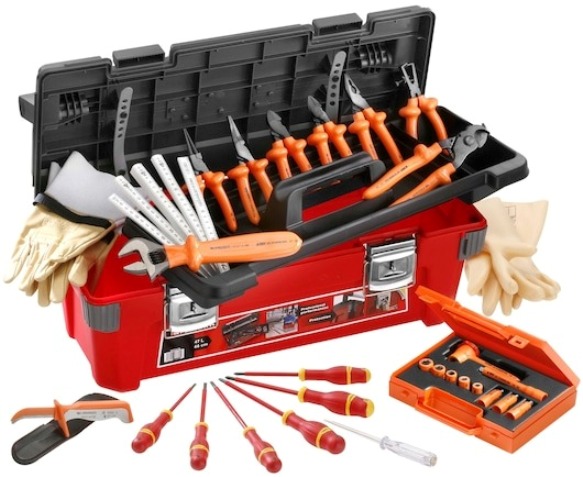
Industrial productivity does not depend only on machines.
It depends on the accuracy of the tools used to assemble, maintain, and repair those machines.
Across industries — from oil & gas facilities in Nigeria to automotive workshops in Europe — one factor consistently determines equipment reliability:
Torque accuracy and tool integrity.
When bolts are over-tightened, components deform.
When under-tightened, vibration causes failure.
Both situations lead to downtime, safety risk, and financial loss.
This is why modern industrial maintenance is moving away from generic hand tools toward engineered precision tooling systems such as FACOM.
Why Precision Hand Tools Matter in Industrial Environments
Many maintenance failures are incorrectly blamed on equipment quality.
However, root-cause analysis in mechanical engineering often reveals a different reason:
Improper fastening caused by inaccurate tools.
Common consequences of non-precision tools:
Bearing failure due to uneven load
Oil leakage from incorrect torque sealing
Bolt fatigue and fracture
Equipment misalignment
Safety hazards in rotating machinery
In regulated industries like power generation, marine engineering, and petrochemical plants, improper torque is not just here a mistake — it becomes a compliance issue.
What Makes FACOM a Professional-Grade Tooling System
Professional tools are not defined by appearance or brand name.
They are defined by repeatable engineering performance.
FACOM tools are designed around three mechanical reliability principles:
1. Controlled Elastic Deformation
The tool flexes within tolerance limits instead of permanently bending or cracking.
2. Repeatable Torque Application
Every fastening action delivers consistent mechanical load.
3. Fatigue Resistance Steel Composition
Alloy treatment prevents sudden breakage under continuous industrial duty cycles.
This ensures the tool behaves the same after years of usage — not just when it is new.
Industrial Challenges in Nigeria and Similar Operating Conditions
Countries with high humidity, heavy load machinery, and continuous duty cycles place extreme stress on tools.
Typical environmental stress factors:
Corrosion due to moisture
Improvised leverage extension
Continuous operation hours
High torque applications
Limited automation support
In such conditions, low-grade tools fail unpredictably, while engineered tools degrade gradually — which is critical for worker safety and maintenance planning.
Total Cost of Ownership vs Purchase Price
Procurement decisions often prioritize the purchase price of tools.
Engineering departments prioritize operational reliability.
Over time, low-quality tools create hidden costs:
Frequent replacement
Production downtime
Equipment damage
Workplace injuries
Maintenance delays
Professional tools cost more initially but reduce lifetime operational expenses significantly.
This is why global industries now follow lifecycle cost evaluation instead of price-based purchasing.
copyright Industrial Tools: A Growing Risk
An increasing problem in developing industrial markets is copyright professional tools.
These tools visually resemble original products but lack:
Proper calibration
Metallurgical treatment
Load tolerance standards
Safety reliability
Such tools may function temporarily but fail under real mechanical load, making them dangerous in critical maintenance environments.
Because of this, industries prefer verified suppliers who provide traceable and genuine sourcing.
A reliable source for genuine industrial supply is
???? Facom Tools in Nigeria ( https://www.brookindustrialtools.com/facom-tools-in-nigeria/ )
which ensures correct specification selection and authentic product availability for industrial applications.
Industries That Require Precision Tooling
Precision hand tools are essential in:
Oil & Gas maintenance
Automotive workshops and fleet service
Power plants and turbines
Marine engineering
Industrial manufacturing
Heavy equipment repair
In these sectors, maintenance quality directly impacts operational uptime.
The Shift Toward Reliability-Driven Maintenance
Modern maintenance strategy is evolving:
Old approach: Fix after failure
Modern approach: Prevent failure
Preventive maintenance depends heavily on tool accuracy because incorrect fastening introduces failure before machines even start operating.
Therefore, professional tooling is no longer optional — it is part of reliability engineering.
Conclusion
Industrial performance is not determined only by machines or workforce skills.
It is determined by consistency.
Consistency in maintenance requires precision in tools.
As industries worldwide adopt reliability-centered maintenance practices, engineered hand tools are becoming a standard requirement rather than a premium choice.
The transition is clear:
Companies are no longer buying tools — they are investing in operational certainty.